0% completed
Introduction to Object-Oriented Programming
On This Page
Key Concepts
The Four Pillars of OOP
Benefits of Object-Oriented Programming
In this chapter, we'll explore the core principles of Object-Oriented Programming (OOP) in Java. Understanding these concepts is crucial for designing scalable and modular applications.
Object-Oriented Programming (OOP) is a programming paradigm that organizes software around objects rather than logic or functions. It emphasizes structuring code into reusable and interconnected units, making it easier to manage and extend.
Key Concepts
- Object: An instance of a class that combines data and methods to represent a specific entity.
- Class: A blueprint that defines the structure and behavior (attributes and methods) of objects.
- Attribute: A variable that holds the data or state of an object.
- Method: A function within a class that defines the behavior or actions an object can perform.
- Constructor: A special method used to initialize new objects of a class.
The Four Pillars of OOP
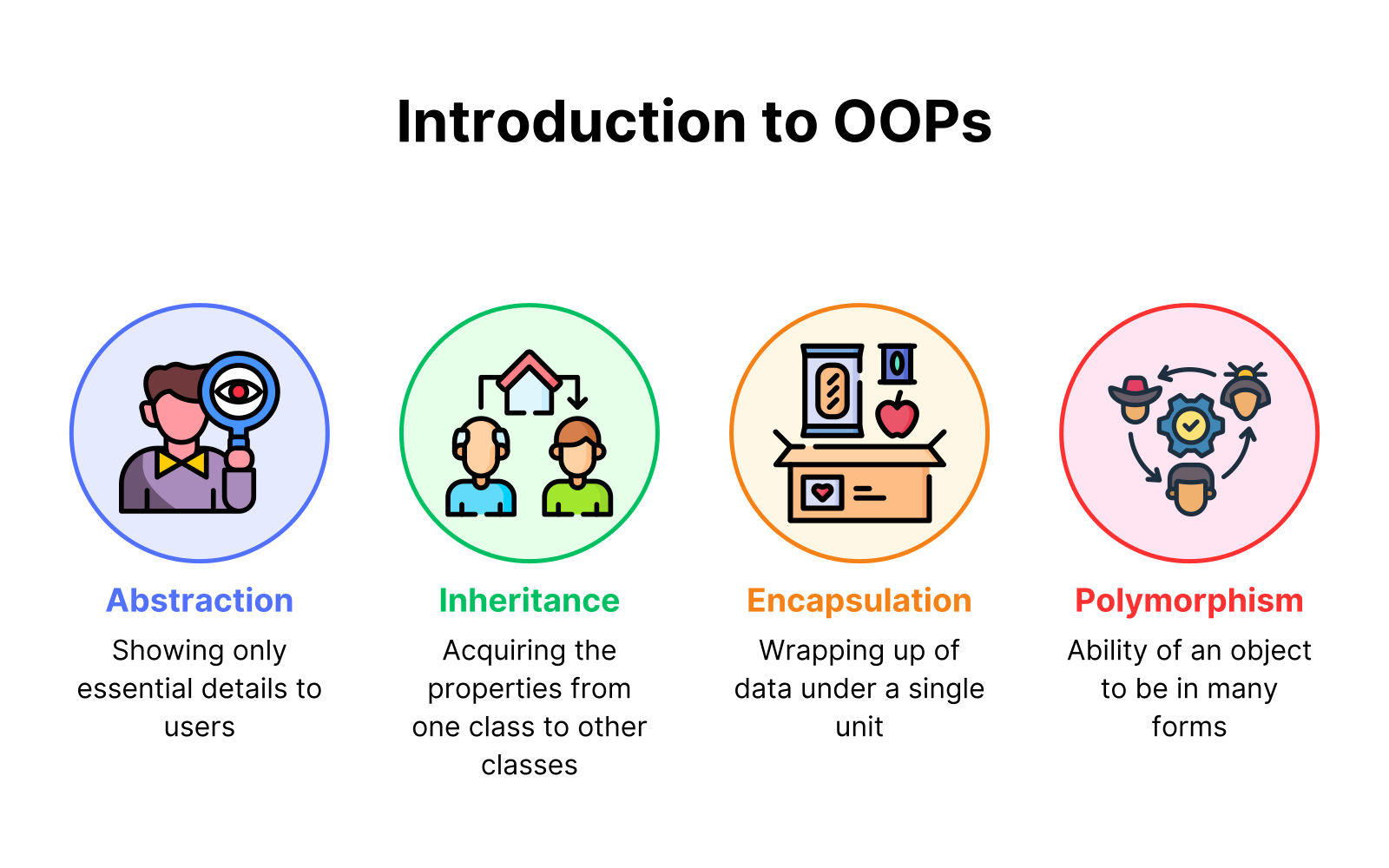
- Encapsulation: Bundles data and methods together in a single unit, restricting access to some components for better control and security. This enhances data protection and ensures consistency in the object’s behavior.
- Inheritance: Allows one class (child class) to reuse or extend the properties and methods of another class (parent class). This promotes code reusability and simplifies the organization of related classes.
- Polymorphism: Enables a single action to behave differently based on the context, such as method overloading or overriding. This provides flexibility in how methods are implemented and called.
- Abstraction: Focuses on exposing only the necessary features of an object while hiding the complex implementation details. This reduces complexity and allows programmers to work with simplified representations.
Benefits of Object-Oriented Programming
- Modularity: Code is organized into discrete classes, making it easier to manage and troubleshoot.
- Reusability: Existing code can be reused through inheritance, saving development time.
- Scalability: Applications can be designed to grow in complexity while remaining manageable.
- Maintainability: Changes in one part of the system can be made without affecting other parts.
- Flexibility: Polymorphism and inheritance make it easier to add new features.
- Improved Collaboration: Clear structure and modularity make it easier for multiple developers to work together.
Object-Oriented Programming (OOP) focuses on structuring code into objects, classes, and methods while leveraging encapsulation, inheritance, polymorphism, and abstraction. These principles improve code modularity, flexibility, and scalability.
Reading Progress
0%
On This Page
Key Concepts
The Four Pillars of OOP
Benefits of Object-Oriented Programming