Grokking the Coding Interview: Patterns for Coding Questions
0% completed
Problem Challenge 2: Rotate a LinkedList (medium)
Problem Statement
Given the head of a Singly LinkedList and a number k, rotate the LinkedList to the right by k nodes.
Constraints:
- The number of nodes in the list is in the range
[0, 500]. -100 <= Node.val <= 100- 0 <= k <= 2 * 10^9
Try it yourself
Try solving this question here:
.....
.....
.....
Like the course? Get enrolled and start learning!
D
dos
· 22 days ago
class Solution {

  public ListNode rotate(ListNode head, int k) {
    if(head == null) return null;
    ListNode sen = new ListNode(-1);
    sen.next = head;

    ListNode s = sen, f = sen;
    int n = 0;

    for(; f.next != null; n++) f = f.next;
    for(int i = 0; i < n-(k%n); i++) s = s.next;

    f.next = sen.next;
    sen.next = s.next;
    s.next = null;

    return sen.next;
  }
}
Show 1 reply

bivani2805
· 2 months ago
for _ in range(rotations):
      curr, prev = head, None
      while curr.next is not None:
        prev = curr
        curr = curr.next

      curr.next = head
      head = curr
      prev.next = None
    return head
# Worst case is O(n^2) this helps me understand the pattern more
Show 1 reply

Eric Imho Jang
· 2 years ago
#class Node:
#  def __init__(self, value, next=None):
#    self.val = value
#    self.next = next

class Solution:
  def rotate(self, head, rotations):
    if rotations == 0:
      return head


    # get length of linked list and get necessary rotation
    length = 0
    current, previous = head, None
    while current:
      length += 1
      current = current.next

    remainder = rotations % length

    if remainder == 0:
      return head

    newHeadIndex = length - remainder
    current = head
    i = 0
    newHead = None
    while current:
      next = current.next
      # find and break the link before newHeadNode
      if i == newHeadIndex - 1:
        current.next = None
      # store new head node
      elif i == newHeadIndex:
        newHead = curre

Mohammed Dh Abbas
· 2 years ago
#class Node:
#  def __init__(self, value, next=None):
#    self.val = value
#    self.next = next

class Solution:
  def rotate(self, head, rotations):

    def get_moves():
      length = 0
      node = head
      while node:
        node = node.next
        length += 1
      remain = length - (rotations % length)
      return remain

    # get the number of moves
    moves = get_moves()

    # move the nodes based on the number of moves
    count = 1
    node = head
    while count < moves:
      count += 1
      node = node.next

    # cut the linkedlist to 2 parts
    next_part = node.next
    node.next = None

    # move to the end of the second part
    node = next_part
    while node and node.next:
      node = node.next

    # link the 2 parts again
    if node:
L
Lucas
· 4 years ago
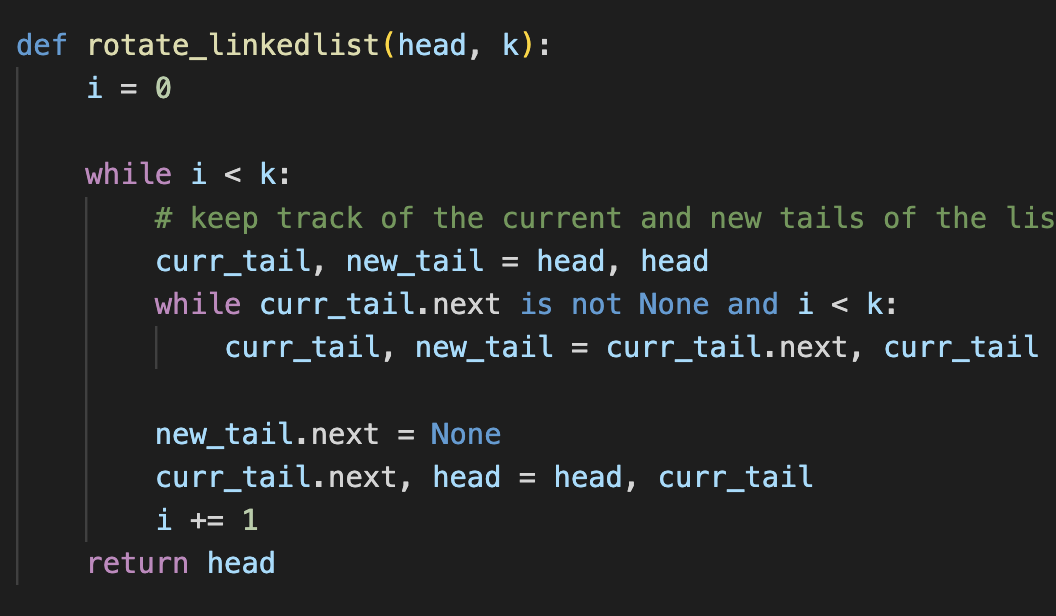
Here is what I came up with! O(N) and a bit more readable IMO. Fire away!
Reading Progress
0%