0% completed
Solution: Flood Fill
Problem Statement
Any image can be represented by a 2D integer array (i.e., a matrix) where each cell represents the pixel value of the image.
Flood fill algorithm takes a starting cell (i.e., a pixel) and a color. The given color is applied to all horizontally and vertically connected cells with the same color as that of the starting cell. Recursively, the algorithm fills cells with the new color until it encounters a cell with a different color than the starting cell.
Given a matrix, a starting cell, and a color, flood fill the matrix.
Example 1:
Input: matrix =
starting cell
.....
.....
.....

Luis Roel
· 3 years ago
class Solution:
  def floodFill(self, matrix, x, y, newColor):
    startingColor = matrix[x][y]
    seen = set()

    def go(x, y):
      if (x, y) in seen:
        return

      if x < 0 or x >= len(matrix):
        return
      if y < 0 or y >= len(matrix[0]):
        return

      seen.add((x, y))

      if matrix[x][y] != startingColor:
        return

      matrix[x][y] = newColor

      go(x + 1, y)
      go(x - 1, y)
      go(x, y + 1)
      go(x, y - 1)

    go(x, y)

    return matrix
Thai Minh
· 3 years ago
from collections import deque
class Solution:
  def floodFill(self, matrix, x, y, newColor):
    # TODO: Write your code here
    # BFS solution, we can use visited to mark the visited cell then rewrite it with color
    # for row in range(len(matrix)):
    #   for col in range(len(matrix[0])):
    # self.visitCellBFS(matrix, x, y, newColor)
    self.visitCellDFS(x, y, matrix, matrix[x][y], newColor)
    return matrix
  def visitCellBFS(self, matrix, row, col, newColor):
    neighbors = deque([(row, col)])
    oldColor = matrix[row][col]
    visited_list = [[False for _ in range(len(matrix[0]))] for _ in range(len(matrix))]

    while neighbors:
      row, col = neighbors.popleft()

      if row < 0 or row >= len(matrix) or col < 0 or col >= len(matrix[0]):
        continue

Elaine Michelle Teh
· 4 years ago
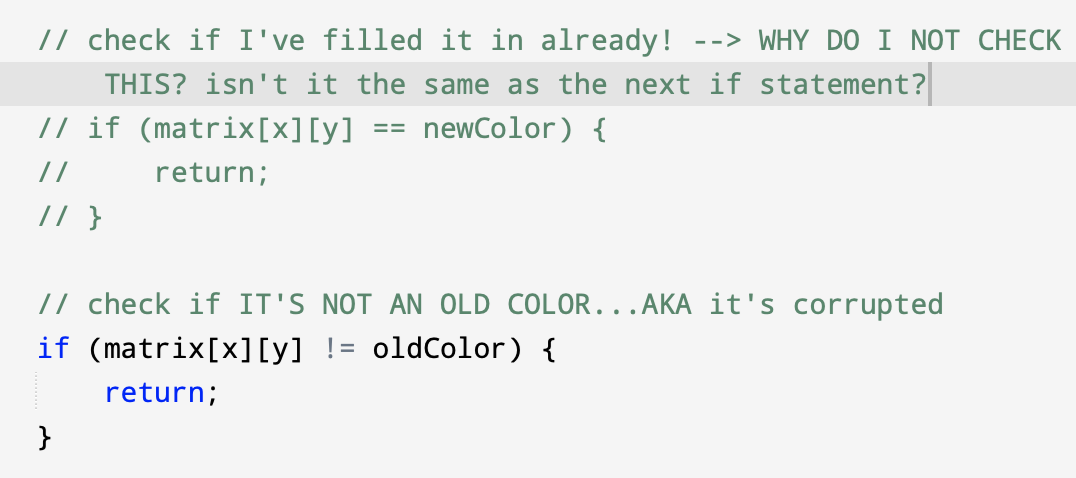
I was wondering for flood fill Easy, why are these 2 checks different and affect the code so much in fillDFS?
Mitch
· 4 years ago
For the examples, are the coordinates for the starting cells reversed?
Reading Progress
0%