Grokking Data Structures & Algorithms for Coding Interviews
Unlock Coding Interview Success: Dive Deep into Data Structures and Algorithms!

Course Overview
In this comprehensive course, we delve deep into the world of data structures & algorithms, covering both the commonly used and the more advanced topics. Participants will learn the principles, usage, and implementation of various data structures, along with their time and space complexities. The course will feature multiple coding problems for each data structure and is tailored for coding interviews. By the end of this course, learners will be adept at selecting and applying the most suitable data structure for any coding problem, ensuring optimized code performance. Prepare to elevate your coding skills and ace those coding interviews with confidence!
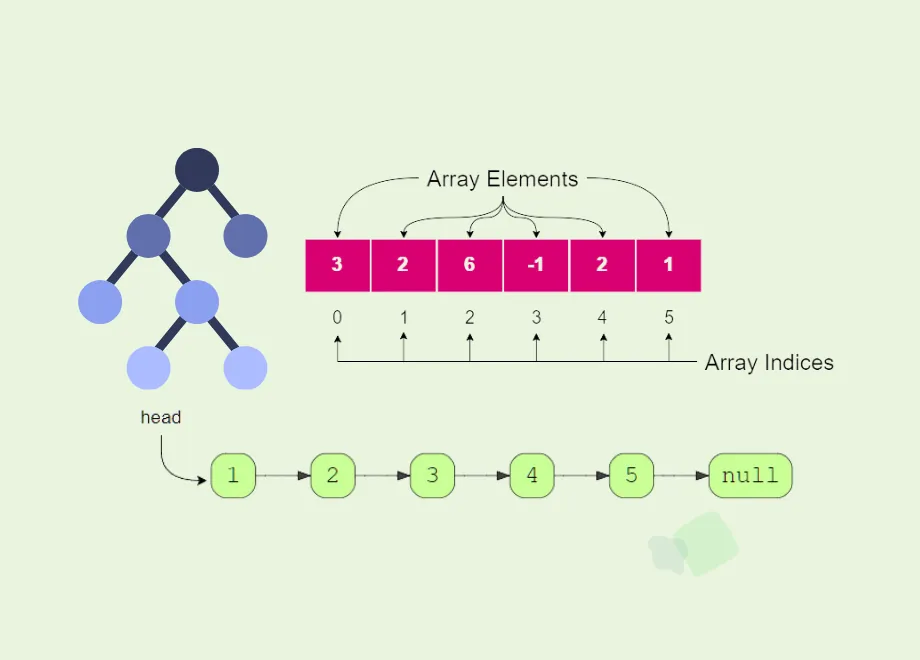
What you'll learn in Grokking Data Structures & Algorithms for Coding Interviews
- Eleven core data structures built from the ground up: arrays, matrices, stacks, queues, linked lists, trees and binary search trees, hash tables, hash sets, heaps, graphs, and tries.
- Practice problems with full solutions, each sitting in the chapter of the structure it exercises rather than shuffled into an undifferentiated pile.
- How each structure behaves in the language you actually use, including the built-in stacks, queues, hash tables, and sets in Python, Java, C++, JavaScript, Go, and C#.
- What happens inside a hash table: hashing, collisions, overflow, and resizing, so you can answer the follow-up instead of just calling the library.
- Visual walkthroughs that advance one frame at a time on the harder algorithms, so you watch a pointer or a heap change rather than infer it from finished code.
- A flashcard deck and an assessment closing every structure and algorithm chapter, and a final exam at the end.
- The four algorithm families interviews lean on hardest: sorting, searching, greedy algorithms, and divide and conquer.
- Big-O from the first chapter, then a complexity analysis on every single solution, covering time and space separately.
- When to reach for which structure, which is the decision an interviewer is really watching you make before you write a line.
- Trees and graphs done properly: binary search tree traversal and operations, depth first and breadth first search, graph representations, and tries for prefix work.
- Every solution in six languages, so nothing is lost translating an idea out of a language you do not write.
- Optional stretch problems in the busiest chapters, clearly marked, for when the main path feels too easy.
Course Content
Array
Introduction to Arrays
Arrays in Different Programming Languages
Problem 1: Running Sum of 1d Array (easy)
Problem 2: Contains Duplicate (easy)
Problem 3: Left and Right Sum Differences (easy)
Problem 4: Find the Highest Altitude (easy)
Stretch Problem: Rotate an Array (medium)
Stretch Problem: Trapping Rain Water (hard)
Flashcards Review
Chapter Assessment
Stack
Introduction to Stack
Implementing Stack Data Structure
Using Built-in Stack in Different Programming Languages
Applications of Stack
Problem 1: Balanced Parentheses (easy)
Problem 2: Reverse a String (easy)
Problem 3: Decimal to Binary Conversion (medium)
Problem 4: Next Greater Element (easy)
Problem 5: Sorting a Stack (easy)
Problem 6: Simplify Path (medium)
Problem 7: Remove All Adjacent Duplicates In String (medium)
Optional Practice: Removing Stars From a String (medium)
Optional Practice: Make The String Great (easy)
Stretch Problem: Evaluate Reverse Polish Notation (medium)
Stretch Problem: Largest Rectangle in a Histogram (hard)
Flashcards Review
Chapter Assessment
Queue
Introduction to Queues
Working with Simple Queues
Queue Implementation in Different Languages
Types of Queue
Diving Deeper – Circular Queues and Deques
Applications and Advanced Concepts
Reverse a Queue (easy)
Implement Stack using Queues (easy)
Generate Binary Numbers from 1 to N
Zigzag Iterator (medium)
Max of All Subarrays of Size 'k' (medium)
Palindrome Check using Queue (easy)
Stretch Problem: Rotting Oranges (medium)
Stretch Problem: Open the Lock (medium)
Flashcards Review
Chapter Assessment
LinkedList
Introduction to LinkedList
Types of LinkedList
Operations on Singly Linked List
Operations on Doubly Linked List
Problem 1: Reverse Linked List (easy)
Problem 2: Remove Duplicates from Sorted List (easy)
Problem 3: Merge Two Sorted Lists (easy)
Problem 4: Find if Doubly Linked List is a Palindrome (easy)
Problem 5: Swap Nodes in Pairs (medium)
Stretch Problem: Reorder List (medium)
Stretch Problem: Odd Even Linked List (medium)
Flashcards Review
Chapter Assessment
Tree & Binary Search Tree
Introduction to Tree
Types of Tree
Binary Search Trees
BST Traversal Techniques
Level Order Traversal and When to Use BFS or DFS
BST Operations
Maximum Depth (or Height) of Binary Tree (easy)
Balanced Binary Tree (easy)
Minimum Difference Between BST Nodes (easy)
Range Sum of BST (easy)
Kth Smallest Element in a BST (medium)
Closest Binary Search Tree Value (medium)
Merge Two Binary Trees (medium)
Stretch Problem: Binary Tree Right Side View (medium)
Stretch Problem: Count Good Nodes in a Binary Tree (medium)
Flashcards Review
Chapter Assessment
Hash Table (aka Hashmap or Dictionary)
Introduction to Hash Tables
Hashing, Collisions, Overflow, and Resizing in Hashtables
Using Hashtable in Different Programming Languages
Problem 1: First Non-repeating Character (easy)
Problem 2: Largest Unique Number (easy)
Problem 3: Maximum Number of Balloons (easy)
Problem 4: Longest Palindrome(easy)
Problem 5: Ransom Note (easy)
Flashcards Review
Chapter Assessment
HashSet
Graph
Introduction to Graph
Types of Graph
Graph Representations
Graph Traversal - Depth First Search(DFS)
Graph Traversal - Breadth First Search (BFS)
Find if Path Exists in Graph(easy)
Number of Provinces (medium)
Find Eventual Safe States (medium)
Minimum Number of Vertices to Reach All Nodes(medium)
Bus Routes (hard)
Flashcards Review
Chapter Assessment
Sorting
Introduction to Sorting Algorithms
Advanced Sorting Techniques
Apple Redistribution into Boxes (easy)
Sort Array by Increasing Frequency (easy)
Sort Vowels in a String (medium)
Reduction Operations to Make the Array Elements Equal (medium)
Divide Array Into Arrays With Max Difference (medium)
Top 'K' Frequent Numbers (medium)
Meeting Rooms II (medium)
Flashcards Review
Chapter Assessment
Searching
Greedy Algorithm
Putting It Together
What people say about our courses


About the Author
Arslan Ahmad
Industry Expertise & Leadership
Arslan Ahmad is the lead author of Grokking Data Structures & Algorithms for Coding Interviews. As the founder of Design Gurus and a former FAANG hiring manager, he has worked at industry giants like Facebook (now Meta) and Microsoft.
He has conducted hundreds of system design interviews, giving him unique insight into what top tech companies look for in candidates.
The course also incorporates expertise from senior engineers at Google, Meta, Amazon, Microsoft, and Uber, ensuring you learn system design best practices from professionals who have built and scaled real-world systems.
500+
Interviews Conducted
10k+
Students Taught
Related Courses
$49.98
$99
FAQs
What is Grokking Data Structures and Algorithms for Coding Interviews?
It is a course that builds up the data structures and algorithms coding interviews are based on, one structure at a time, and attaches practice problems to each. It covers eleven data structures and four algorithm families, and every problem comes with a worked solution and a complexity analysis in six languages.
Who is this course for?
Engineers who need the foundation before the pattern work: new graduates, self-taught developers who never took an algorithms course, and experienced engineers who have spent years in a framework and have not implemented a heap or a trie since university. If you can write code but freeze when someone says the word "amortised", this is the right starting point.
How is this different from Grokking the Coding Interview?
This course is organised by data structure, and teaches you what each one is, how it works internally, and what it costs. Grokking the Coding Interview is organised by pattern, and teaches you to recognise which technique a question is asking for. Foundations first, then pattern recognition. If you are not confident explaining how a hash table resizes or why a heap gives you the smallest element cheaply, start here and move on to the patterns course afterwards.
Which data structures and algorithms does it cover?
The structures are arrays, matrices, stacks, queues, linked lists, trees and binary search trees, hash tables, hash sets, heaps, graphs, and tries. The algorithm chapters are sorting, searching, greedy algorithms, and divide and conquer. The opening chapter covers types of data structures and an overview of Big-O so the complexity analysis later on makes sense.
Which programming languages are supported?
Python, Java, C++, JavaScript, Go, and C#. Every solution is given in all six, and the chapters on stacks, queues, hash tables, and hash sets include lessons on the built-in implementations each language ships with, which is what you will actually reach for in an interview.
Do I need prior experience with algorithms?
No. Each structure is introduced from scratch before any problem uses it, and the problems inside a chapter climb from easy upwards, with the harder optional ones kept separate so they never block you. You need to be able to write basic code in one of the six supported languages, and nothing beyond that.
How is the course structured?
One chapter per structure or algorithm family. Each chapter opens with lessons on how the structure works, how it is implemented, and how your language exposes it, then moves into practice problems. Each problem is a lesson where you attempt it, followed by a separate solution lesson with the approach, the code, and the complexity analysis. Each chapter then closes with a flashcard deck and an assessment, and the course ends with a chapter on choosing between the structures, plus a final exam.
Is there any practice, or is it only reading?
Every structure and algorithm chapter carries practice problems, each with a full worked solution in six languages, and closes with a flashcard deck and an assessment. The course ends with a final exam that draws across the whole thing. The busiest chapters also carry optional stretch problems, clearly marked, for anyone who wants a harder question than the chapter needs.
Is the course text-based or video-based?
Text-based, with diagrams, runnable code, and frame by frame visual walkthroughs on the harder algorithms. Text works better here because you will constantly move between a diagram, a complexity bound, and an implementation, and that is far quicker on a page than in a timeline.
Do I get a certificate of completion?
Yes. Design Gurus issues a certificate once you have completed the course, and you can share the link directly or add it to your LinkedIn profile.

